
 INJECTABLES
 ORAL
 STEROIDS CYCLE
 SEX PILL
 HGH & PEPTIDES
 FAT BURNERS
 WEIGHT LOSS
 USA WAREHOUSE
 EUROPE WAREHOUSE
No products in the cart.
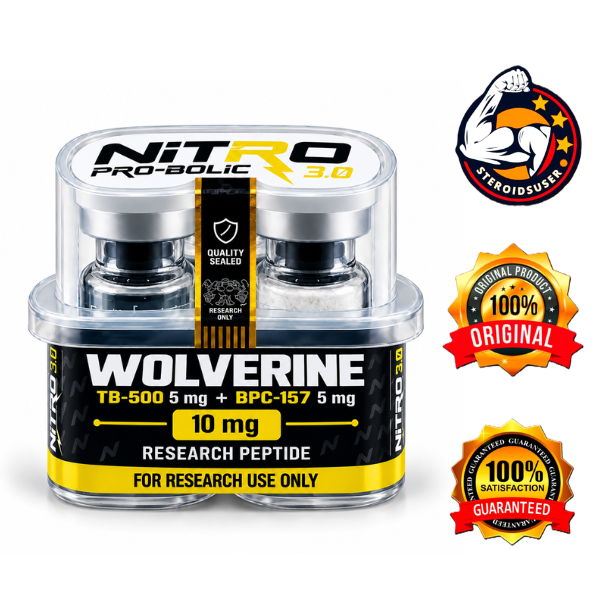
Wolverine 5+5mg | BPC-157+TB-500 – Nitro Probolic
$179.00
Product Name: Wolverine 5+5 mg – BPC-157 + TB-500
Listed Brand: Nitro Probolic / Nitro Pro Bolic
Manufacturer: Not Independently Verified — Roidsdeal Short Description Lists Nitro Labs
Intended Active Ingredients: BPC-157 + TB-500 (Ingredient Conflict Requires Verification)
Declared Strength: BPC-157 5 mg + TB-500 5 mg
Total Intended Peptide Content: 10 mg
Product Form: Experimental Research Peptide Blend — Physical Form Not Confirmed
Packaging: Not Verified. Roidsdeal’s conflicting short description lists one 10 mg peptide vial and one 2 mL bacteriostatic water vial.
Classification: Experimental Peptide Combination / Research Peptides
Research Areas: Preclinical Tissue-Repair Mechanisms, Connective Tissue Biology, Cell Migration, Cytoskeletal Organization, Cellular Signaling, and Inflammatory Responses
Clinical Evidence: Predominantly Preclinical — Human Therapeutic Safety and Efficacy of This Combination Have Not Been Established
Half-Life: Not Reliably Established for the Combination
Regulatory Status: Neither BPC-157 nor TB-500 Is Established as an FDA-Approved Human Therapeutic Ingredient
Administration Status: Research Use Only — Not Approved for Human Therapeutic Administration
Critical Product Verification: The product title, Roidsdeal long description, and both Finest Gears descriptions identify BPC-157 5 mg + TB-500 5 mg. However, Roidsdeal’s short description identifies an entirely different formulation: Ipamoreline 5 mg + CJC-1295 5 mg. The manufacturer, ingredient identity, TB-500 molecular identity, packaging, purity, sterility, and batch-specific documentation require verification before publication.
1. Product Overview
Wolverine 5+5 mg is presented as an experimental research peptide blend associated with the Nitro Probolic brand.
According to the product title, Roidsdeal long description, and Finest Gears descriptions, the intended formulation contains 5 mg of BPC-157 and 5 mg of TB-500, giving a combined declared peptide content of 10 mg.
Both compounds have attracted scientific interest in research involving connective tissue biology, cellular signaling, and processes associated with tissue repair.
However, the supplied Roidsdeal short description identifies an entirely different formulation: Ipamoreline 5 mg and CJC-1295 5 mg.
It also lists Nitro Labs as the manufacturer and a separate 2 mL bacteriostatic water vial.
Consequently, the actual ingredient identity, manufacturer, and packaging must be verified before this product information is published.
2. What Is Wolverine?
Wolverine is a commercial designation for an intended combination of two experimental peptides, BPC-157 and TB-500. It is not a recognized pharmacological classification or approved medical treatment.
BPC-157
BPC-157 is a synthetic peptide consisting of 15 amino acids. Preclinical studies have investigated its relationship with gastrointestinal tissues, connective tissue biology, and experimental injury responses.
Research has explored signaling processes associated with blood vessels, inflammation, and tissue maintenance.
However, reliable human clinical evidence remains insufficient to establish therapeutic effectiveness.
TB-500
TB-500 is a commercial designation associated with thymosin beta-4-related peptides.
Thymosin beta-4 participates in actin-associated cellular processes, including cell movement and cytoskeletal organization.
The exact molecular identity of products described as TB-500 requires verification. Findings involving full-length thymosin beta-4 cannot automatically be attributed to every TB-500 preparation.
The Wolverine formulation combines these two research compounds, but no established clinical evidence demonstrates that their combination produces superior therapeutic effects.
3. How Does Wolverine Work?
The proposed biological activities of Wolverine are based primarily on research involving its individual intended ingredients.
BPC-157 and Cellular Signaling
Preclinical investigations have explored BPC-157 in experimental tissue-injury models.
Researchers have examined potential relationships with vascular signaling, inflammatory pathways, and connective tissue responses.
These observations remain preliminary and do not establish clinical effectiveness in humans.
TB-500 and Cytoskeletal Processes
TB-500 is associated with thymosin beta-4-related research involving actin regulation.
Actin contributes to cellular structure, movement, and organization. Related research has investigated how these processes participate in normal tissue responses.
However, the exact peptide sequence must be confirmed before applying findings from thymosin beta-4 studies to a commercial TB-500 product.
Combined Peptide Activity
Combining BPC-157 and TB-500 does not automatically produce additive or synergistic effects.
The interactions, pharmacokinetics, biological performance, and long-term safety of this particular combination have not been adequately established in controlled human studies.
4. Medical Uses & Clinical Information
Wolverine is an experimental peptide combination, not an established medical treatment.
Muscle Tissue Research
BPC-157 has been investigated in preclinical models involving experimental muscle injuries and biological responses associated with tissue damage.
These findings cannot establish that Wolverine accelerates muscle recovery in humans.
Tendon and Ligament Research
Experimental studies have explored BPC-157 in tendon and ligament injury models.
Such investigations contribute to scientific understanding of connective tissue signaling but do not demonstrate approved therapeutic applications.
Cell Migration Research
Thymosin beta-4-related research has examined cell migration, actin dynamics, and cytoskeletal organization.
Results involving full-length thymosin beta-4 should not be assumed applicable to unverified TB-500 preparations.
Inflammatory Signaling
Preclinical studies involving BPC-157 have examined pathways associated with inflammatory responses.
The clinical significance of these findings remains uncertain.
Combination Research
There is insufficient controlled human evidence to establish that combining BPC-157 and TB-500 improves tissue recovery, injury repair, or regeneration.
Neither compound is established as an FDA-approved human therapeutic ingredient.
5. Product Specifications & Packaging
| Specification | Details |
|---|---|
| Product Name | Wolverine 5+5 mg |
| Listed Brand | Nitro Probolic / Nitro Pro Bolic |
| Manufacturer | Not Independently Verified |
| Conflicting Manufacturer Reference | Nitro Labs |
| Intended Ingredient 1 | BPC-157 |
| Intended Ingredient 1 Content | 5 mg |
| Intended Ingredient 2 | TB-500 |
| Intended Ingredient 2 Content | 5 mg |
| Total Intended Peptide Content | 10 mg |
| Conflicting Ingredients | Ipamoreline 5 mg + CJC-1295 5 mg |
| Classification | Experimental Peptide Combination |
| Category | Research Peptides |
| Physical Form | Not Confirmed |
| Peptide Packaging | One 10 mg Vial Claimed in Conflicting Short Description |
| Bacteriostatic Water | 2 mL Claimed in Conflicting Short Description |
| Final Kit Configuration | Verification Required |
| Combination Half-Life | Not Reliably Established |
| Human Therapeutic Approval | Not Established |
| Batch-Specific Testing | Claimed Available; Not Reviewed |
| Purity and Sterility | Not Independently Verified |
The intended BPC-157 and TB-500 composition is supported by the product title and long descriptions.
However, the short-description ingredient conflict is critical because the alternative formulation contains entirely different peptides.
The total 10 mg quantity cannot establish compound identity.
The precise molecular identity of TB-500, packaging, and laboratory documentation also require confirmation.
6. Research Use & Scientific Supervision
Wolverine is described as an experimental research peptide combination.
Neither proposed ingredient has an established approved therapeutic role in human injury recovery.
The intended 10 mg content represents the combined declared peptide quantity, not a recommended single dose.
No validated human dosing regimen, administration route, or treatment protocol has been supplied for this commercial product.
The possible inclusion of bacteriostatic water does not establish sterility or suitability for injection.
Research requires verified compound identity, appropriate scientific oversight, and compliance with applicable laboratory and regulatory requirements.
Because the supplied descriptions identify conflicting ingredients, this product should not be treated as an authenticated research material until the discrepancy is resolved.
7. Possible Side Effects & Safety Limitations
The human safety profile of the BPC-157 and TB-500 combination has not been adequately established.
Reliable controlled clinical evidence is insufficient to determine adverse-event frequencies or long-term risks.
Important safety uncertainties include:
- Unknown long-term effects of BPC-157 exposure
- Inadequately characterized human safety of TB-500
- Potential hypersensitivity or immune reactions
- Uncertain effects on vascular and inflammatory signaling
- Unknown interactions between the two peptides
- Differences in biological activity between TB-500 preparations
- Risks associated with incorrect peptide identity
- Potential contamination, impurities, or sterility failures
Experimental findings involving vascular signaling and tissue remodeling require further investigation.
The absence of established adverse-event rates does not demonstrate safety.
Furthermore, research involving individual peptides cannot establish the safety profile of the combined formulation.
8. Warnings & Precautions
BPC-157 and TB-500 are experimental compounds whose human therapeutic safety and efficacy remain insufficiently established.
Wolverine should not be represented as an FDA-approved treatment for muscle injuries, tendon damage, ligament injuries, inflammation, or tissue regeneration.
Preclinical observations do not guarantee clinical benefits.
The safety of the combination during pregnancy, breastfeeding, childhood, or adolescence has not been established.
Potential interactions with medications and underlying medical conditions remain inadequately characterized.
Ingredient verification is particularly important because Roidsdeal’s short description identifies Ipamoreline and CJC-1295 rather than BPC-157 and TB-500.
The exact TB-500 molecular identity and the manufacturing quality of the final blend also require verification.
Research-use labeling does not establish product safety or remove applicable regulatory obligations.
9. Storage & Handling
The supplied descriptions do not establish verified storage temperatures, stability data, or expiration requirements for Wolverine.
Storage requirements may depend on the precise peptide composition, physical form, excipients, and packaging.
Because the product’s physical presentation is unconfirmed, powder-specific or solution-specific storage instructions should not be assumed.
If bacteriostatic water is included, its volume, labeling, composition, and expiration information require confirmation.
The supplied sources do not establish validated compatibility or stability after combining the peptide material with any accompanying liquid.
Keep research materials clearly identified, securely stored, and away from children and pets.
Products with uncertain ingredient identity or compromised packaging should not be assumed suitable for laboratory or human use.
10. Frequently Asked Questions (FAQs)
What is Wolverine 5+5 mg?
It is presented as an experimental research blend containing 5 mg of BPC-157 and 5 mg of TB-500, although the actual ingredients require verification.
Is Wolverine proven to accelerate tissue recovery?
No. Available evidence does not establish that this combination safely or effectively accelerates human tissue recovery.
Does the package include bacteriostatic water?
Roidsdeal’s conflicting short description lists a 2 mL vial. Because that description also identifies different active ingredients, the actual package contents remain unverified.
Is Wolverine FDA-approved?
No FDA-approved human therapeutic status has been established for the intended BPC-157 and TB-500 combination.
11. Conclusion & Medical Disclaimer
Wolverine 5+5 mg is presented as an experimental peptide blend containing BPC-157 and TB-500, with an intended declared content of 5 mg per compound.
Both peptides are associated with preclinical research involving cellular signaling and tissue-related biological processes.
However, the combination’s therapeutic effectiveness and safety in humans have not been established.
The critical ingredient discrepancy, manufacturer identity, packaging, TB-500 molecular identity, purity, sterility, and batch-specific documentation require verification.
Research Use Only. Not approved for human therapeutic administration or intended for self-administration, treatment, prevention, or cure of any disease.
This description is for scientific product identification and does not constitute medical advice.
Related products
-26%
Out of stock
-17%
Out of stock
-12%
Out of stock
Original price was: $250.00.$220.00Current price is: $220.00.
-22%
Out of stock
Original price was: $230.00.$180.00Current price is: $180.00.
-17%
Original price was: $180.00.$149.00Current price is: $149.00.
-22%
Out of stock
Original price was: $190.00.$149.00Current price is: $149.00.
-26%
Out of stock
-12%
Out of stock
-13%
Original price was: $160.00.$139.00Current price is: $139.00.
-16%
Original price was: $190.00.$159.00Current price is: $159.00.
-16%
Out of stock
-20%
Out of stock